

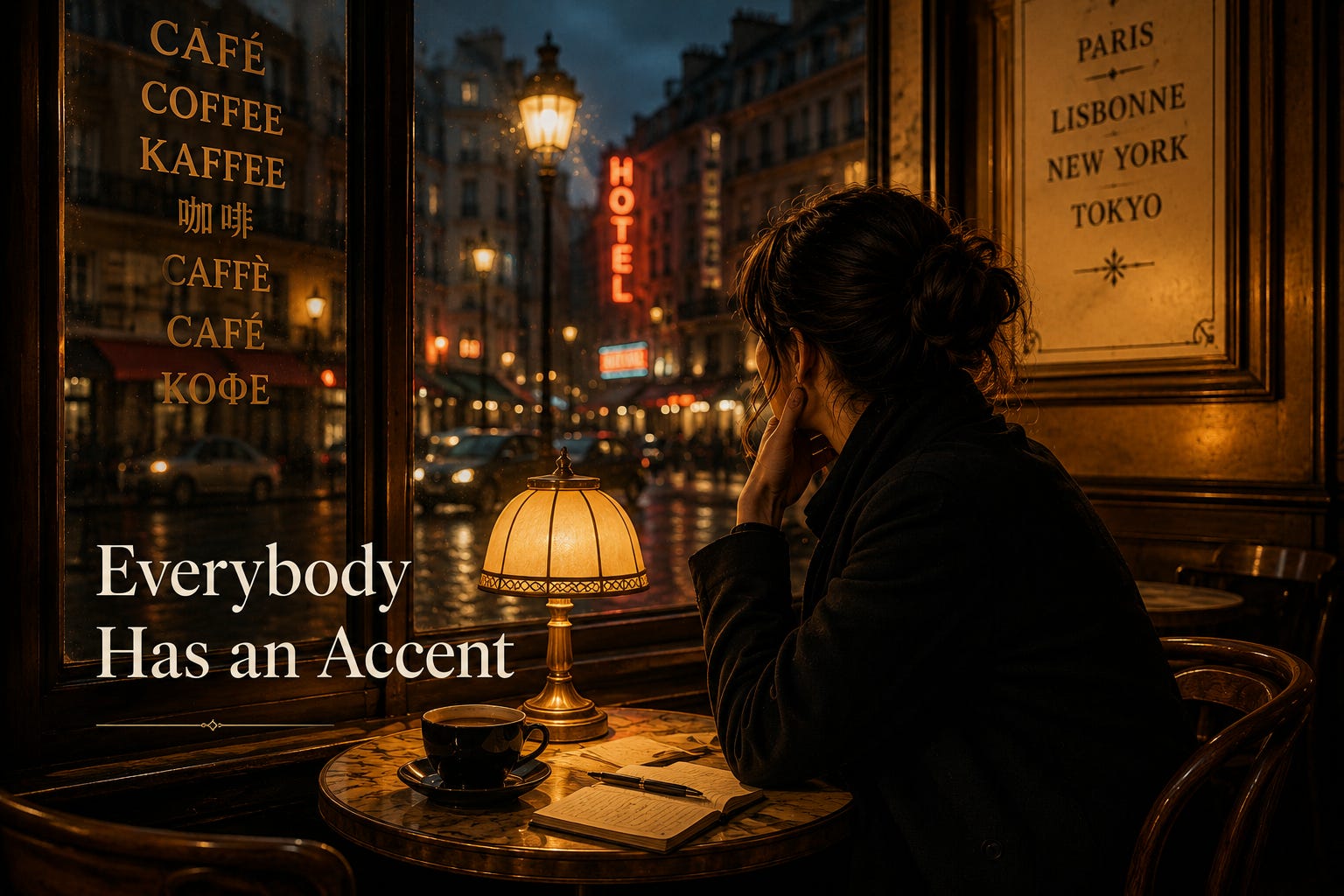
I have an accent. Actually, I have several. I go vaguely British when talking about machine learning and existentialism, French when I become facetious, and full-on linguistic Russian roulette whenever somebody asks me where I’m from and expects a one-word answer.
Many people are self-conscious about their accents because some locals frown upon them. I’ve always found this logic slightly bizarre. If these very locals move to another country, region, or even town, they instantly develop an accent themselves. Which means we all have accents. Some people just happen to live in the only place where their particular one sounds invisible. That’s the fascinating part: familiarity masquerades as neutrality.
People treat certain accents as if they were the factory settings of humanity itself. Everybody else sounds foreign while they themselves supposedly emerged from the Earth already speaking in “normal”. But accents are simply proof that your tongue has traveled, carrying stamped linguistic luggage. You hear movement in them: geography, migration, cultural collisions - entire histories ricocheting around somebody’s vowels.
Honestly, I find accents comforting. They remind me the world exists beyond whichever neighborhood currently thinks it’s the center of civilization. What’s strange is that the people most bothered by accents are often the people with the narrowest sense of place. Hearing a rolled R suddenly becomes an attack on the local operating system. Meanwhile, I’m over here collecting foreign words as if one day I’ll be able to convert them into rent. I love words that resist direct translation: “zeitgeist”, “schadenfreude”, “saudade”. Minute linguistic compression algorithms carrying entire emotional philosophies. English imports these words because occasionally it realizes it cannot do the emotional heavy lifting alone.
Because certain words do more than communicate information. They communicate texture, rhythm, worldview. They reveal the kind of conceptual furniture somebody keeps in their head. An accent does the same thing. It tells you a person has existed elsewhere. And honestly, I’m suspicious of people who insist they “don’t have an accent”. That level of certainty usually indicates they haven’t spent enough time being confused.
Confusion is underrated. The world makes much more sense once you’ve embarrassed yourself in multiple languages, once you’ve stood in front of somebody trying to remember whether a word is masculine, feminine, formal, informal, or somehow all four simultaneously. Once you’ve realized that your personality changes slightly depending on which language you’re speaking. That realization unsettled me because it’s true. Certain ideas feel more natural in certain accents. British English somehow makes existential despair sound academically peer-reviewed. French can make boredom sound curated. American English turns confidence into a renewable resource. Every language carries its own emotional geometry. Language doesn’t merely express thought; it shapes the emotional architecture around it.
Which is probably why multilingual brains tend to overthink everything. Every word arrives carrying multiple meanings, tones, histories, and emotional temperatures simultaneously. Communication stops being linear and starts resembling a conspiracy board with red strings attached to every syllable.
Sometimes I think logic itself becomes unstable when exposed to too many perspectives at once. Which is probably why I once wrote down: “Logic is madness playing a haunted violin”. I still stand by that.
Because what people often call “logic” is simply local habit wearing a fake mustache of universality. A person grows up hearing one cadence, one worldview, one understanding of normality, and eventually mistakes familiarity for objective truth. Then somebody arrives pronouncing words differently and the entire structure suddenly starts wobbling.
But accents are not intellectual deficiencies. If anything, they often indicate the opposite. They suggest adaptation, movement, exposure, the ability to exist between systems without completely dissolving inside them. You know what’s actually difficult? Rebuilding your identity in another language. Humor becomes especially unforgiving because jokes rely on rhythm, timing, implication, social calibration, and the microscopic emotional distance between words. One misplaced syllable and suddenly you’re no longer witty - you’re just a confused foreigner accidentally proposing to a waiter.
Still, there’s something strangely liberating about becoming visibly foreign somewhere. Once you do, you stop taking social performance quite so seriously. You realize identity itself is partially improvisation. Everybody is code-switching. Everybody performs different versions of themselves depending on context. Accents simply make the performance audible.
Maybe that’s why internationally minded people tend to feel easier to talk to. They usually understand that identity is negotiable, that there are multiple ways to exist correctly, that no single culture owns the monopoly on coherence. People with a global outlook develop cognitive flexibility almost by accident. They become comfortable with contradiction, ambiguity, translation failure. They understand that human beings are contextual creatures desperately trying to sound certain while improvising their way through existence.
The aggressively local types often crave rigidity because rigidity feels safe. They want language fenced neatly into categories: correct pronunciation, correct behavior, correct worldview. But the world itself no longer operates that way. Everything overlaps now: cultures, languages, timelines, identity. We are all hybrids now; some people just haven’t noticed yet.
Personally, I stopped aspiring to sound native years ago. Native to what exactly? One city? One country? One version of reality? I’d rather sound traveled. I’d rather sound like several unfinished thoughts occurring simultaneously in different airports. I’d rather carry visible evidence that my mind has crossed borders.
Because ultimately, accents are not distortions of language. They are proof that language survived movement. And in a world increasingly obsessed with flattening everybody into algorithmic sameness, I find that strangely beautiful. There’s authenticity in remaining unflattened.
American English turns confidence into a renewable resource.
French can make boredom sound curated.